In football, some matches must produce a winner after 90 or 120 minutes, but the score remains level. In such cases, a penalty shootout becomes the final method of deciding the outcome. It is a tense battle of wits, where a player’s finishing ability and a goalkeeper’s anticipation can determine the fate of an entire team.
So, What is a penalty shootout? It is a method of determining the winner when two teams remain level after regular time and extra time, in competitions that require a team to advance or win the championship. Fans following bong da truc tuyến on 90P TV are often particularly interested in this moment because just one missed kick can completely change the course of a match.
When is a penalty shootout used?
Not every drawn football match has to go to a penalty shootout. This method is only used when the competition regulations require a winning team to be determined but the two teams remain level after the prescribed playing time.
In knockout matches, the two teams usually play 90 minutes of regular time. If the score remains level and the competition format provides for it, the sides will play two periods of extra time, each lasting 15 minutes. If the winner still cannot be determined, a penalty shootout will take place.
However, the specific format can vary depending on the competition. Some competitions may use a shootout immediately after 90 minutes, while other matches apply extra time before entering the shootout.
Basic penalty shootout rules
What is a penalty shootout? In terms of how it is played, it is a series of kicks in which players from the two teams take turns shooting from the penalty mark with the aim of putting the ball into the opponent’s goal. Each kick involves a direct contest between the kicker and the goalkeeper.
Under the football laws, each team takes five initial kicks if the match has not yet been decided. The two teams must take an equal number of kicks. The team that scores more goals after five kicks wins.
If the teams still have the same number of goals after five kicks, the shootout continues one kick at a time. When one team scores and the other fails to score from the same number of kicks, the team that scores wins.
This creates enormous pressure for the player taking the kick. Fans watching highlight bóng đá ngoại hạng anh or major competitions have witnessed extended shootouts with many dramatic moments.
How do players take penalty kicks?
Before the shootout begins, the referee carries out the procedure to determine which goal will be used and which team will take the first kick. These two factors can significantly affect the players’ mentality, particularly in matches with an intense atmosphere.
Only players who are on the pitch when the match ends are eligible to participate in the shootout, except in certain situations involving a goalkeeper replacement under the laws. Players take turns shooting from a distance of 11 meters.
The kicker can choose to shoot with power, use technique, deceive the goalkeeper, or place the ball into difficult corners. Meanwhile, the goalkeeper must try to read the direction of the shot and react within an extremely short period.
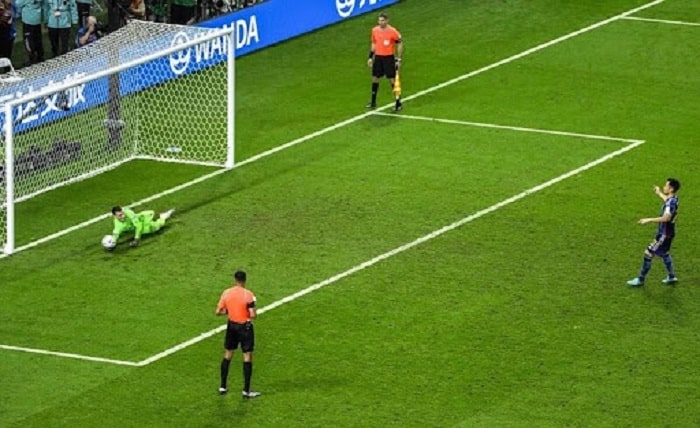
The player takes a kick from the penalty mark while the goalkeeper tries to anticipate the direction of the ball and make the save
The goalkeeper’s role in a penalty shootout
The goalkeeper can become the hero or the most unfortunate figure in the shootout. Unlike a penalty kick during regular play, the goalkeeper enters a shootout under particularly intense psychological pressure.
A good goalkeeper needs to study the opponent’s finishing habits. The run-up, body position, and placement of the standing foot can provide clues that help the goalkeeper predict the direction of the ball.
However, reflexes remain a decisive factor. The distance from the penalty mark to the goal is only 11 meters, so the goalkeeper has almost no time to change their decision after the ball is kicked.
Fans who regularly follow 90p TV are certainly familiar with images of goalkeepers successfully saving a decisive kick and helping their team secure victory.
Psychology determines success or failure
Technique is not the only factor determining the outcome of a shootout. Match psychology can make a huge difference. A player who has excellent finishing ability during a match can still miss when standing in front of tens of thousands of spectators.
The pressure becomes even greater when a player is selected to take the final kick. This is often the kick that can directly bring victory or cause the team to be eliminated.
Therefore, many coaches choose players with composure, experience, and the ability to control their emotions to take penalties. Young players can also be given the opportunity if they demonstrate confidence and strong finishing ability.
Memorable situations like these often quickly appear in highlight bóng đá ngoại hạng anh videos, especially after matches that end in dramatic fashion.
Tactics when taking a penalty kick
There is no single formula that guarantees a successful penalty. Players can choose different finishing methods depending on their strengths and ability to read the situation.
Some players prefer to strike powerfully into the upper corner, where it is difficult for the goalkeeper to reach. Others choose to place the ball into a low corner to improve accuracy. Some players also take a gentle kick down the middle of the goal if they notice that the goalkeeper tends to dive to one side.
The most important thing is for the player to decide on the approach beforehand and execute it confidently. Changing the decision at the last second can cause the kick to lack power or accuracy.
For those following bong da truc tuyến, small differences in a player’s run-up, placement of the standing foot, or direction of their gaze can all create memorable moments.
Common mistakes when taking penalties
One of the most common mistakes is inaccurate finishing caused by psychological pressure. The ball may go wide of the post, over the crossbar, or be saved by the goalkeeper.
Players can also make technical mistakes with their run-up or the placement of their standing foot. A shot that is too powerful but poorly controlled can sometimes be more dangerous than a moderately powerful kick that is accurate.
Goalkeepers must also follow specific rules when facing the kick. They are not allowed to act illegally to gain an advantage. The referee has the authority to order the kick to be retaken or take disciplinary action if a violation is detected.
Such developments mean that matches updated on 90Phut TV always contain additional elements of surprise when they enter the decisive shootout.
Memorable penalty shootouts in football
Football history has witnessed many penalty shootouts that have remained in the memories of fans. The World Cup, Champions League, EURO, and club competitions have all featured extended and emotional shootouts.
One of the characteristics that makes penalty shootouts exciting is their unpredictability. The team that played better over 120 minutes is not necessarily the team that wins. Just a few inaccurate kicks can completely turn the match around.
Moments when goalkeepers save decisive kicks often become iconic images of an entire competition. Conversely, players who miss can also face enormous pressure from public opinion.
These situations are often compiled into highlight bóng đá ngoại hạng anh videos or videos featuring memorable penalty shootouts for fans to watch again.
The difference between a penalty kick and a penalty shootout
Many people who are new to football easily confuse a penalty kick during a match with a penalty shootout. A penalty kick is a situation that can occur during play when the defending team commits an offense punishable inside the penalty area.
A penalty shootout, meanwhile, is organized to determine the winner after the match has ended according to the prescribed format. Players take individual kicks, and there is no organized attacking situation like there is with a normal penalty kick.
This distinction is important because the player’s psychological and tactical preparation is also completely different.
Those watching 90 Phút TV can easily notice the change in atmosphere on the pitch when the referee asks the two teams to prepare for the shootout.
The significance of a penalty shootout
What is a penalty shootout? Essentially, it is a method that allows football to produce a clear result in matches where a winner must be determined. This format prevents competitions from having to organize another match to decide the outcome.
Although its fairness is often debated, the penalty shootout remains an indispensable part of modern football. It creates emotional moments and demonstrates players’ composure in high-pressure situations.
For fans, the final minutes before each kick always bring a unique sense of suspense. This unpredictability is precisely what makes penalty shootouts one of the most exciting parts of football.
Conclusion
What is a penalty shootout? It is a method of determining the winner used in matches that require a winning team to be identified when the two sides remain level after the prescribed playing time. Every kick requires accuracy, composure, and the ability to control one’s emotions.
Fans can follow matches and decisive moments through 90P TV, while also watching important situations again after the match. For those who love bong da truc tuyến, shootouts are always one of the most eagerly anticipated moments of every major football match. highlight bóng đá ngoại hạng anh videos also help preserve memorable kicks and saves in the history of the world’s most popular sport.