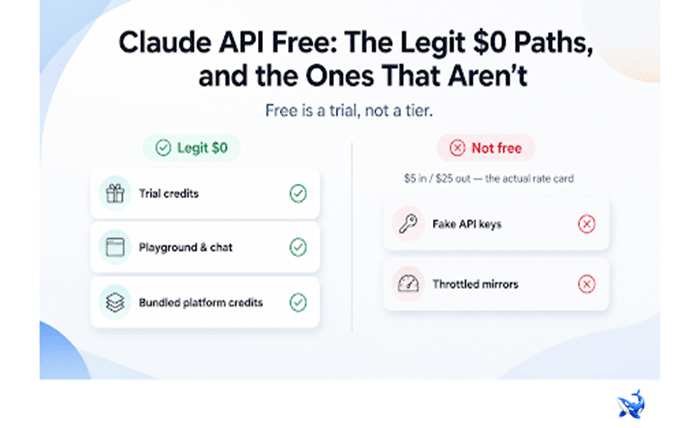
Anthropic has no perpetual free API tier, so a search for a Claude API free option is really a search for which $0 paths are legitimate — and the honest answer is short: trial credits, playground and chat access, and credits bundled into a platform plan you already pay for. All three are genuinely $0. None of them is free forever, and the API’s own rate card is why: the current flagship, Claude Opus 5, lists at $5.00 per million input tokens and $25.00 per million output tokens, with cached input at $0.50 per million (vendor-reported). Comparing against a live rate card — and the live rate card for Claude Sonnet 5 shows what the mid-tier actually costs per million tokens — is the cleanest way to tell which of those $0 paths is a real, temporary credit and which is a fake engineered to end in a charge.
Type “claude api free” into a search engine and the results follow a tired script: pages promising free API keys, tutorials that quietly die after the first request, “unlimited” mirrors that throttle you within hours. The query is understandable — Claude is the model many developers want to test before they pay for it — but most of those results are trials wearing a disguise, and some are outright credential harvesters. Before you hand over an email, a key, or a card, you need to know which “free” survives contact with reality and which is engineered to end in a charge.
Anthropic has no perpetual free API tier
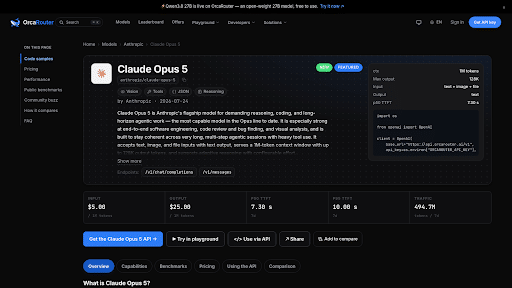
Start from the rate card, because every “free” claim is measured against it. Anthropic runs no free API tier, and its models ship as closed weights, so they cannot be self-hosted; the only legal ways to run them are the vendor’s own API and platforms that route to it. The published numbers are unambiguous — vendor-reported and verified by OrcaRouter on August 18, 2026: $5.00 per million input tokens, $25.00 per million output tokens, and $0.50 per million for cached input, an 80% reduction. Caching is the closest thing this pricing has to a real discount, and it is the lever that makes an honest $0 evaluation possible later in this article.
Because the flagship genuinely costs money to serve, nobody gives it away forever. Artificial Analysis — the independent lab whose live board tracks model intelligence and cost — prices each of its Intelligence Index tasks at $2.34 for Claude Opus 5, and estimates the full index across 100 million output tokens at $3,836.05 (checked August 22, 2026). Those are flagship economics: every $0 path has to be subsidized by someone, and subsidies expire.
The three $0 paths that are real
The three legitimate routes all cost nothing up front, and all of them end.
| Path | What you actually get | How long it lasts |
| Playground & chat access | Interactive use in Anthropic’s web interface and in chat apps built on the model | Session- or subscription-capped |
| Sign-up trial credits | A small credit balance on an API account for testing | Days to weeks; burns fast at $25 per million output |
| Bundled platform credits | Usage of the model included in a platform plan you already pay for | Per billing cycle |
Start with the playground if it is available in your region — it is the fastest way to feel what Claude’s large context window actually does with a real codebase. Next, spend trial credits on a handful of scripted API calls; at $25 per million output tokens those credits evaporate faster than people expect, so make every call count. In practice, the most useful $0 access is bundled platform credits: usage of the model included in a plan you already pay for, refreshed each billing cycle. Each of these is genuinely $0. None of them grants a free API key or a free rate-limit tier — a result that promises “free Claude API” is describing one of these three paths with the word “free” doing the marketing.
What “free” is worth — and what a router changes
Once the credits run out, you pay the list price, and this is where it helps to know what “free” is really worth. $5 in / $25 out is a serious number: one long, cache-miss-heavy generation can run into double digits. The cheapest legitimate way to evaluate Claude is not a magic key — it is trial credits spent through cached input, where a stable prompt prefix re-uses the $0.50-per-million cached rate instead of paying $5 for input over and over.
This is also where routing platforms matter more than the search results imply. OrcaRouter, for example, passes Anthropic’s list price through at 0% markup, so the official rate card is the rate you actually pay — no added premium on the flagship, and one API key reaches 200-plus models across Anthropic, OpenAI, Google, Meta, Mistral, xAI, DeepSeek and more (OrcaRouter’s own catalog, checked August 22, 2026). To be clear, 0% markup does not mean free. It means nobody is charging you extra on top of the vendor’s own price — which is the difference between a cheap way to test and an expensive one, and it is what makes routing the same traffic between cheap and expensive models a real cost lever instead of a marketing phrase.
The traps: how fake “free” claims work
The scam formulas are consistent. One: a page offering “free Claude API keys” — these harvest credentials, or sell you a key that dies after the first request. Two: a “free mirror” claiming to run the flagship — usually a smaller model repackaged, and the gap shows immediately on long-context work. Three: “unlimited” chat tiers that throttle you into unusability within hours. Four: pages that rank for “claude api free” and quietly funnel you into a subscription you did not ask for.
The tell never changes. A model whose every independent benchmark task costs $2.34 to run is not going to be offered free, forever, by anyone. When a deal sounds too good for Claude, assume it is a trial in disguise, and read the terms before you hand over a key or a credit card. Legitimate free access announces its limits up front; scams reveal them only after you are committed.
A $0 test plan that stays honest
Put the pieces together in order. One: open the playground or a chat app that exposes the model and paste the largest, messiest real task you have — a repository, a failing test suite, a stack of migration notes — so the context window does the work before you spend anything. Two: if the answer must be scripted, spend trial credits on API calls and structure the prompt so its stable prefix hits the $0.50-per-million cached rate. Three: if your platform plan bundles Claude credits, treat that as the main test budget and save the trial for raw API work. Four: if no $0 path exists in your region, accept that the entry ticket is $5 in / $25 out and run one focused test instead of ten casual ones.
It is worth knowing what you are comparing against. Artificial Analysis currently ranks Claude Opus 5 #1 of 185 models on its Intelligence Index at 63.05 in the max-effort configuration (live board, checked August 22, 2026) — the same lab whose $2.34 per-task cost shows why nobody can afford to give the model away. Test at the effort level you intend to ship with; comparing a default-effort run against a max-effort benchmark compares two different models.
The takeaway
“Claude API free” is not a tier; it is a question with a specific answer. Anthropic has no perpetual free API, and the real $0 paths — trial credits, playground and chat access, bundled platform credits — all expire by design. That is not a reason to skip evaluating the model; it is a reason to be deliberate. With cached input at $0.50 per million tokens, an independent #1 score of 63.05, and one honest test planned around a real task, a serious evaluation costs close to nothing. For production volume, budget the $5 / $25 list price and treat routing as a cost question rather than a price hunt: a router like OrcaRouter passes the list price through at 0% markup, so the flagship costs the same everywhere — the only variable left is whether the model does your job at the quality you need.
Sourcing note: the $5.00 / $25.00 / $0.50-cached rate card and the absence of a perpetual free API tier are vendor-reported figures, verified by OrcaRouter on August 18, 2026. The three real $0 routes (trial credits, playground and chat access, bundled platform credits) and the fake-free trap patterns come from OrcaRouter’s own free-access guide. Benchmarks — Intelligence Index 63.05 (#1 of 185), cost per Intelligence Index task $2.34, and full-index cost $3,836.05 — are independent measurements from Artificial Analysis’ live board, checked August 22, 2026. OrcaRouter’s 0%-markup pass-through and one-key access to 200-plus models are OrcaRouter’s own data, checked August 22, 2026.